Curvature estimate
An $L^p$ theory compatible with the junction
For stable minimal multiple-junction surfaces, the second fundamental forms satisfy an $L^{2p}$ estimate for $1
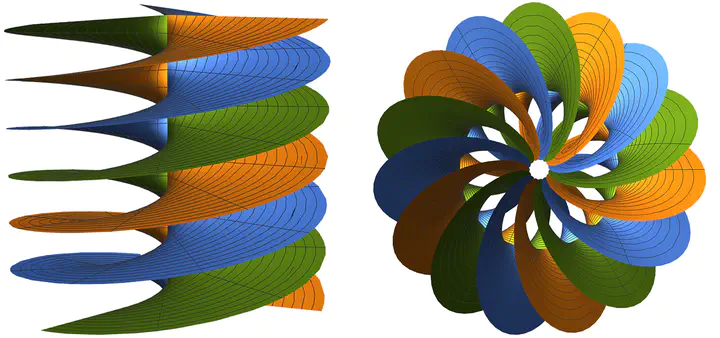 Triple junction surfaces
The minimal surfaces meeting in triples with equal angles along a common boundary naturally arise from soap films and other physical phenomenon. They are also the natural extension of the usual minimal surface. In this paper, we consider the multiple junction surface and show the Bernstein’s Theorem still holds for stable multiple junction surface in some special case. The key part is to derive the $L^p$ estimates of the curvature for multiple junction surface.
The paper extends curvature estimates and Bernstein-type rigidity from smooth minimal surfaces to weighted multiple-junction surfaces sharing a common free boundary.
Curvature estimate
For stable minimal multiple-junction surfaces, the second fundamental forms satisfy an $L^{2p}$ estimate for $1
Compact junction
A complete, orientable, stable minimal multiple-junction surface in $\mathbb R^3$ with quadratic area growth, compact common boundary, and constant pairwise angles has flat sheets.
Straight junction
For a triple junction meeting at $120^\circ$, the flatness conclusion also holds when the common boundary is a straight line, under the corresponding completeness, stability, and area-growth assumptions.
Simons’ inequality is applied sheet by sheet and combined with the global stability inequality using test functions that satisfy the junction compatibility condition. The conormal boundary terms do not disappear automatically; the weighted balance law reorganizes them into a controllable expression. Iteration of the resulting $L^p$ estimate with large cutoffs and quadratic area growth forces the curvature to vanish.

My research interests include Geometric Analysis and Partial Differential Equations.