Exact index
The Morse index is determined by the complementary regions
If the network cuts $\mathbb S^2$ into $F$ regions, then its Morse index is exactly $F-1$. All negative modes have eigenvalue $-1$ and are locally constant along the edges.
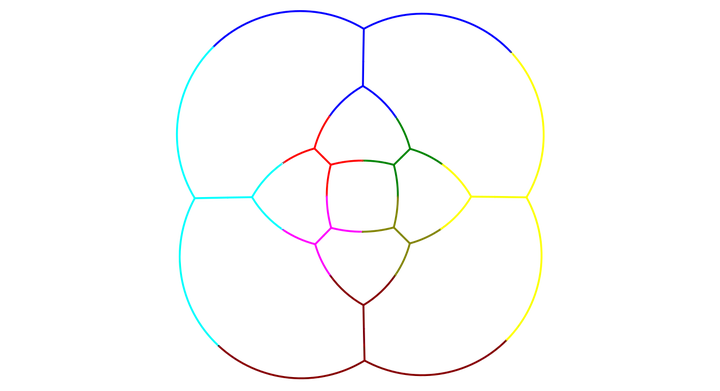 Partition of 8-2 type network
In this paper, we will compute the Morse index and nullity for the stationary embedded networks in spheres. The key theorem in the computation is the index (and nullity) for the whole network is related to the index (and nullity) of small networks and the Dirichlet-to-Neumann map defined in this paper. Finally, we will show that for all stationary triple junction networks in $\mathbb{S}^2$, there is only one eigenvalue (without multiplicity) $-1$ which is less than 0 and the corresponding eigenfunctions are locally constant. Besides, the multiplicity of eigenvalues 0 is 3 for these networks and their eigenfunctions are generated by the rotations on the sphere.
This paper develops a spectral decomposition method for stationary geodesic networks and applies it to every embedded closed triple-junction network in the round two-sphere.
Exact index
If the network cuts $\mathbb S^2$ into $F$ regions, then its Morse index is exactly $F-1$. All negative modes have eigenvalue $-1$ and are locally constant along the edges.
Exact nullity
Every embedded closed stationary triple-junction network has nullity three, with the zero modes generated precisely by infinitesimal rotations of $\mathbb S^2$.
Decomposition formula
For an arbitrary partitioned network, the index and nullity split into contributions from the subnetworks, a finite-dimensional Dirichlet-to-Neumann operator, and explicit matching spaces at the cut points.
The Jacobi operator is $L=\Delta+1$, acting on edgewise functions satisfying the compatibility conditions imposed by geometric variations at junctions. After cutting the network, solutions of the Jacobi equation on each piece are encoded by a self-adjoint Dirichlet-to-Neumann map. The resulting index formula turns the global spectral calculation into finite-dimensional linear algebra and, together with the classification of spherical triple-junction networks, yields the exact spectrum at and below zero.

My research interests include Geometric Analysis and Partial Differential Equations.