Sharp regularity
An optimal bound for non-branch singularities
The non-branch singular set is empty in dimension $n=2$, discrete in dimension $n=3$, and has Hausdorff dimension at most $n-3$ for every $n\geq4$.
We establish a sharp bound on the Hausdorff dimension of the non-branch singular set of branched stable minimal immersed hypersurfaces whose singular sets have locally finite $\mathcal H^{n-2}$-measure: the non-branch singular set is empty when $n=2$, discrete when $n=3$, and has Hausdorff dimension at most $n-3$ when $n\geq 4$. We also construct a non-flat stable minimal cone in $\mathbb R^4$ arising from a branched minimal immersion whose vertex is a non-branch singularity. Taking products with Euclidean factors yields examples whose non-branch singular sets have Hausdorff dimension exactly $n-3$, showing that our regularity bound is sharp in every dimension $n\geq 3$. The main ingredients in our proof are a generalized Schoen inequality and a corresponding branched sheeting theorem near stationary classical cones and unions of hyperplanes.
This work develops a regularity theory for branched stable minimal immersed hypersurfaces. The conclusions are sharp, and the examples show that the remaining singularities are a genuine feature of the immersed setting rather than an artifact of the proof.
Sharp regularity
The non-branch singular set is empty in dimension $n=2$, discrete in dimension $n=3$, and has Hausdorff dimension at most $n-3$ for every $n\geq4$.
Sharpness examples
We construct a non-flat stable minimal cone in $\mathbb R^4$ arising from a branched minimal immersion. Its products with Euclidean factors attain the $n-3$ bound in every dimension $n\geq3$.
Analytic mechanism
The proof combines a generalized Schoen inequality with a sheeting theorem near stationary classical cones and unions of hyperplanes.
The construction of our sharpness examples starts from a minimal surface in $\mathbb S^3$ obtained by desingularizing two orthogonal Clifford tori. The image below visualizes this starting model, which provides the geometric input for the subsequent construction of a branched stable minimal cone in $\mathbb R^4$.
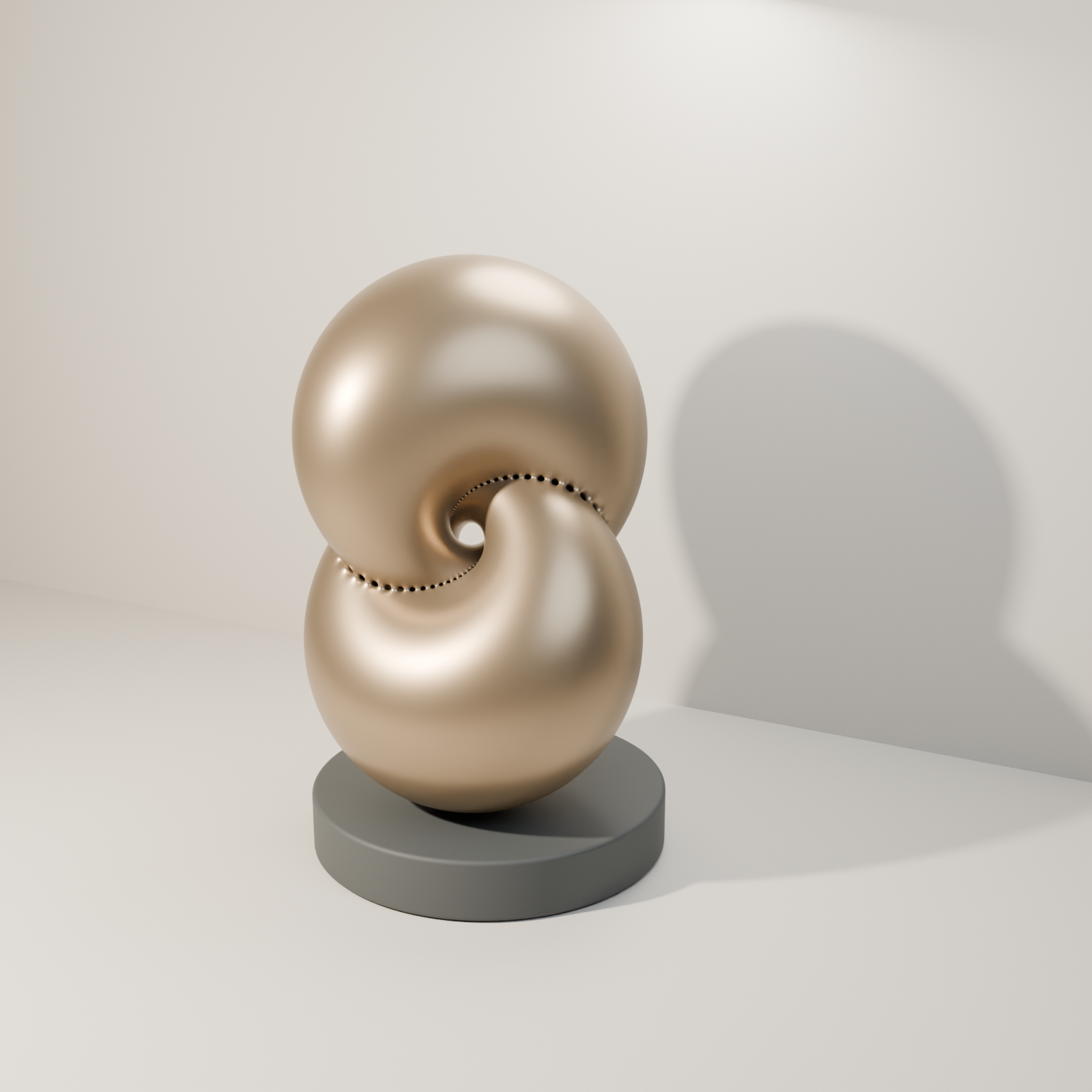
The two resources below give a closer view of how the project developed and of the geometry behind one of its principal examples.
Research record
This note follows the route from the capillary prototype through numerical screening, the small-$k$ expansion, the local linear repair, and the cutoff ODE. GitHub Copilot and Cursor Composer 2 were used chiefly to turn hand calculations into rapidly testable code; the numerical evidence guided the choice of formula, while the final verification remained analytic.
Interactive geometry
An interactive 3D viewer provides a geometric preview of the desingularization: rotate and zoom the model, or isolate individual regions to inspect how the two tori are joined.

My research interests include Geometric Analysis and Partial Differential Equations.