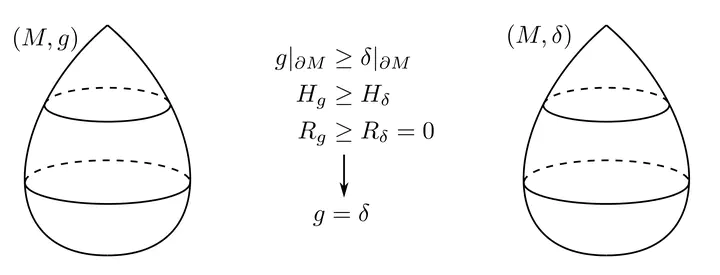
Suppose $M$ is a rotationally symmetric convex set in $\mathbb{R}^3$ with two different metric $g$ and $\delta$ (the standard Euclidean metric). Then for some special $M$ with the condition $g_{\partial M}\ge \delta_{\partial M},H_g\ge H_\delta, R_g\ge R_\delta$, then we can show that $g=\delta$.
Main results
This paper treats scalar-curvature rigidity for compact three-manifolds whose
reference boundary is rotationally symmetric and weakly convex, including
smooth, conical, and truncated models.
Euclidean rigidity
Boundary comparison determines the interior
If $R_g\geq0$, the induced boundary metric and mean curvature dominate those of the Euclidean reference, and the nonsmooth dihedral angles are no larger, then the manifold is flat under the stated pole hypotheses.
Endpoint geometries
Disks, cones, and spherical poles are all included
The theorem covers boundaries cut off by planar disks, boundaries with conical tips, and boundaries with smooth spherical poles. Standard balls and right circular cones are important special cases.
Extensions
Hyperbolic and circle-symmetric analogues
The same capillary framework yields corresponding rigidity statements in hyperbolic space and in nonpositively curved spaces with an $\mathbb S^1$ symmetry.
Proof strategy
The argument minimizes a capillary functional whose prescribed contact angle
varies along the rotational boundary. Stability and Gauss–Bonnet force the
minimizing disk to be infinitesimally rigid, after which a foliation propagates
the equality. The main difficulty is ensuring that a nontrivial minimizer
exists near a conical or spherical pole; local constant-mean-curvature barrier
foliations reduce those cases to the planar-end problem.